The Office of the United States Trade Representative has unveiled a potentially transformative fee structure targeting Chinese maritime dominance. After investigating China’s targeting of maritime, logistics, and shipbuilding sectors, the USTR is proposing several tiers of fees that could fundamentally reshape shipping economics at U.S. ports.
The Fee Structure in Detail
1. Fees on Chinese Operators
Any vessel operated by a Chinese company could face:
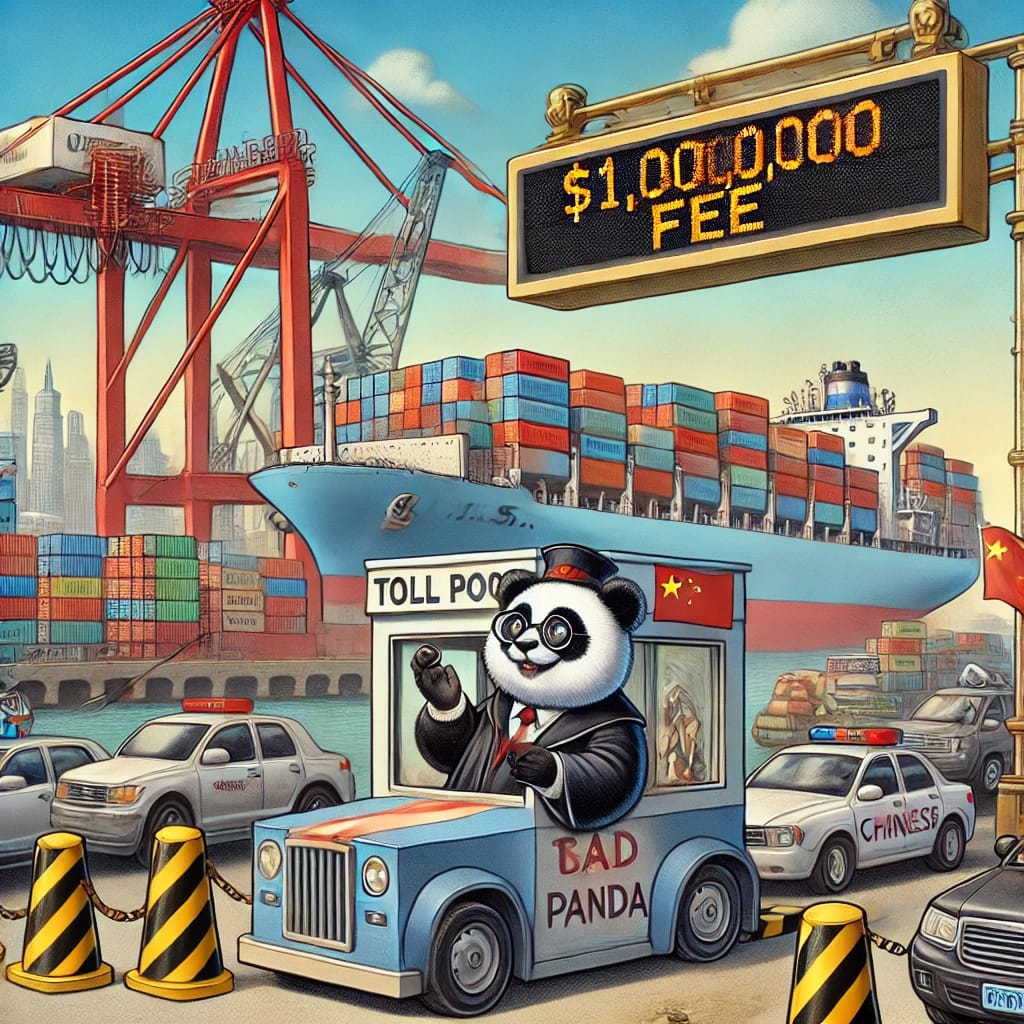
- A flat fee of up to $1,000,000 per port call at a U.S. port, OR
- A fee calculated at up to $1,000 per net ton of vessel capacity
2. Fees Based on Chinese-Built Vessels in Fleet
For operators with Chinese-built vessels in their fleet:
- Vessels from operators with 50%+ Chinese-built fleet: up to $1,000,000 per U.S. port call
- Vessels from operators with 25-50% Chinese-built fleet: up to $750,000 per U.S. port call
- Vessels from operators with 1-25% Chinese-built fleet: up to $500,000 per U.S. port call
Alternatively, any operator with at least 25% Chinese-built vessels in their fleet could be charged a flat additional fee of up to $1,000,000 per vessel per U.S. port call.
3. Fees Based on Future Orders
Operators with orders at Chinese shipyards could face:
- 50%+ of future vessels ordered from China: up to $1,000,000 per U.S. port call
- 25-50% of future vessels ordered from China: up to $750,000 per U.S. port call
- 1-25% of future vessels ordered from China: up to $500,000 per U.S. port call
Or alternatively, if 25%+ of an operator’s orders over the next 24 months are from Chinese shipyards, they could face a flat fee of up to $1,000,000 per vessel per U.S. port call.
4. Fee Remission Program
The proposal includes a potential rebate system for operators using U.S.-built vessels, allowing for refunds of up to $1,000,000 per U.S. port call made by a U.S.-built vessel.
Beyond Fees: Cargo Reservation System
The proposal also outlines a progressive reservation system for U.S. exports:
- Immediate implementation: 1% of U.S. exports reserved for U.S.-flagged vessels
- Year 2: 3% of exports reserved for U.S.-flagged vessels
- Year 3: 5% of exports reserved (with 3% on U.S.-built vessels)
- Year 7: 15% of exports reserved (with 5% on U.S.-built vessels)
The Market Impact
These fees would dramatically alter shipping economics. For context, a typical containership call at a U.S. port might generate $500,000-$2,000,000 in revenue. The proposed fees could effectively eliminate profits or even make U.S. port calls unprofitable for operators with Chinese ties.
The tiered approach creates a “contagion effect” where even having a single Chinese-built vessel in a fleet triggers fees, potentially forcing operators to choose between complete disengagement from Chinese shipbuilding or accepting higher costs.
Strategic Considerations
This approach reveals several strategic priorities:
- Long-term view: The stepped cargo reservation system shows the USTR recognizes rebuilding U.S. shipping capacity will take years
- Encouraging U.S. shipbuilding: The fee remission for U.S.-built vessels creates financial incentives for domestic construction
- Breaking dependencies: By targeting not just Chinese operators but anyone using Chinese-built vessels, the proposal aims to reduce China’s shipbuilding dominance (currently over 50% of global tonnage)
- LOGINK concerns: The specific mention of restricting access to China’s logistics platform highlights cybersecurity and data concerns
Next Steps
The USTR has set these key dates:
- March 10, 2025: Deadline for requests to testify at public hearing
- March 24, 2025: Public hearing and written comment deadline
- Seven days after hearing: Rebuttal comment period closes
For businesses in the maritime sector, understanding these proposals and engaging in the comment period will be crucial as the final implementation could dramatically reshape maritime costs and routing decisions.
https://ustr.gov/sites/default/files/301%20CN%20Maritime%20Logisitcs%20Shipbuilding%20-%20FRN_1.pdf